

Warning: Undefined variable $location_class in /home/maritime/public_html/wp-content/themes/maritime2014/single.php on line 40
Warning: Undefined variable $post_otherimages in /home/maritime/public_html/wp-content/themes/maritime2014/single.php on line 56
Warning: Undefined variable $s in /home/maritime/public_html/wp-content/themes/maritime2014/inc/shortcodes.php on line 345
Warning: Undefined variable $post in /home/maritime/public_html/wp-content/themes/maritime2014/inc/shortcodes.php on line 368
Warning: Attempt to read property "ID" on null in /home/maritime/public_html/wp-content/themes/maritime2014/inc/shortcodes.php on line 368
Warning: Trying to access array offset on null in /home/maritime/public_html/wp-content/themes/maritime2014/functions.php on line 1356
Warning: Trying to access array offset on null in /home/maritime/public_html/wp-content/themes/maritime2014/functions.php on line 1356
Warning: Trying to access array offset on null in /home/maritime/public_html/wp-content/themes/maritime2014/functions.php on line 1356
Warning: Trying to access array offset on null in /home/maritime/public_html/wp-content/themes/maritime2014/functions.php on line 1356
Warning: Trying to access array offset on null in /home/maritime/public_html/wp-content/themes/maritime2014/functions.php on line 1356
Posted on: 17 November 2022
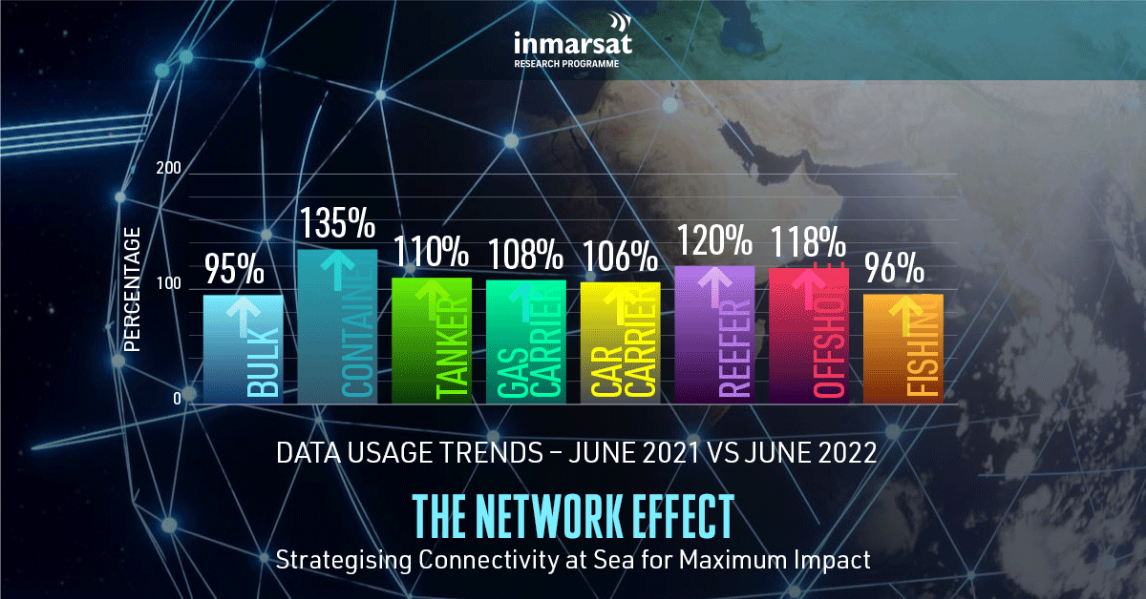
Inmarsat has published ‘The Network Effect – Strategising Connectivity at Sea for Maximum Impact‘ report, which looks at the current and future trend trajectories of maritime connectivity and demonstrates that by taking a strategic approach that is fit for present and evolving needs, shipping companies can better meet their current and future business goals.
As ships, shipping companies and cargo owners are becoming increasingly connected, digital technologies are becoming an established feature of the present and a key element of the future of shipping.
Optimising and decarbonising ships to meet the demands of a changing world requires a range of technologies onboard to improve fleet utilisation, streamline commercial processes, reduce emissions, develop operational preparedness, enable ship-shore transparency, and improve crew retention. All of which demand significant investments of time and money from operators and a sustained focus on long-term goals.
To thrive in ever-changing market conditions, operators need to understand how the transition will play out in the coming years and put strategic emphasis on an effective and compatible connective framework.
Terrestrial and satellite connectivity technologies have already helped shipping to advance its digital capabilities at sea. As technologies such as AI and big data analytics gather momentum, the demand for connectivity is exponentially growing.
Inmarsat’s recent study highlighted that data usage associated with shipboard business applications increased by 131% from June 2021 to June 2022, with crew-related data consumption growing by 149% in the same time frame.
Download the full report here.
